Get a Certification in the Six Sigma Belt Certification Course in India to Improve Your Business.
Six Sigma courses teach how to apply the Six Sigma methodology, a data-driven approach to improving business processes by reducing errors and increasing efficiency. As a leading provider of Six Sigma training, Aspire Training Research Consulting focuses on minimizing defects throughout the process to achieve better results. The Six Sigma methodology employs various tools and techniques to analyze and improve processes, leading to higher customer satisfaction and increased profitability.
Six Sigma methodology employs a range of tools and techniques to analyse and enhance processes, ultimately improving customer satisfaction and profitability. It is commonly used to improve quality and reduce defects in business processes, aiming for near-perfect outcomes. The term “Six Sigma” refers to six standard deviations in a data set, indicating that a defect should only occur after six such deviations.
Comprehensive curriculum: We cover all the fundamental concepts to advanced statistical
analysis of both green belt and yellow belt courses with real-world application through DMAIC
methodology, process improvement techniques, and business analytics.
Practical-oriented and industry-relevant training: We opt for practical training rather
than a theoretical way of teaching.
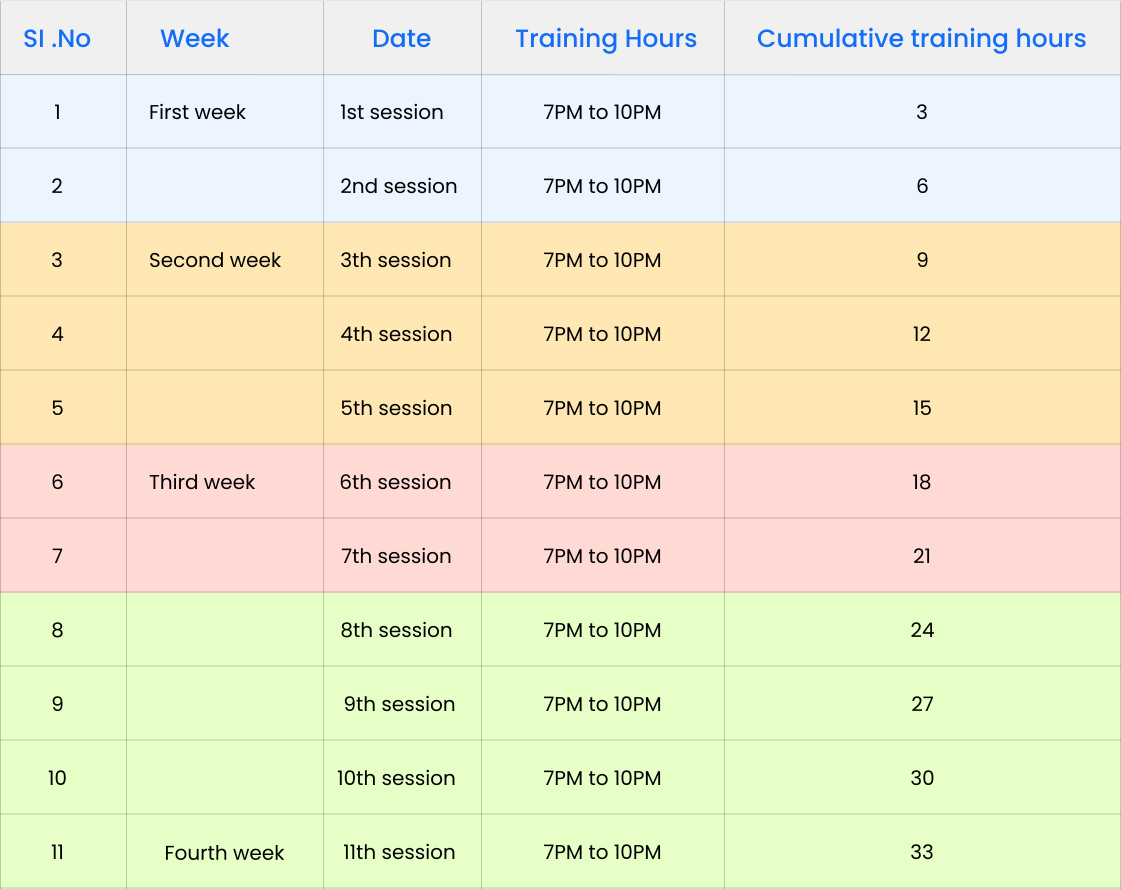
Flexible learning options: Flexible evening training sessions from 7 PM to 10 PM
Open door to a wide range of opportunities: After the course, you will have a lot of job
opportunities, offering higher salaries and growth opportunities.
Expert mentors and supportive learning environment:With years of expertise and
experience, our mentors will provide personalized guidance and mentorship, ensuring each of our
learners gains the knowledge they need to stand out in this field.
Choosing Aspire Training Research Consulting means investing in your career and future by gaining valuable insights and analytics that unlock opportunities for professional growth and business success.
Six Sigma Course Schedule
Previously published schedule. Please ask our team for current dates.
Learn About the Green Belt Course
The Six Sigma Green Belt course is an intermediate certification designed to equip individuals with the knowledge and skills to support process improvement initiatives and lead smaller projects. It emphasizes the use of the DMAIC methodology (Define, Measure, Analyze, Improve and Control) to improve quality and efficiency.
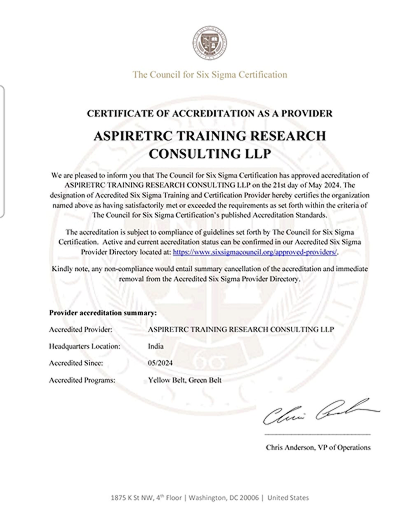
Council for Six Sigma Certification (CSSC)
Accredited Green Belt Certified Course
The facility will carry out projects across various sectors including retail, e-commerce, web and social media, banking, supply chain, healthcare retail, insurance, entrepreneurship, finance and more. Six Sigma is a structured, data-driven approach aimed at improving business processes by identifying and eliminating defects, reducing variation and building overall quality. Based on statistical principles and established quality control methods, Six Sigma enables organizations to optimize operations, reduce costs and provide higher quality products and services to their customers.
The approach originated from practical challenges in manufacturing, where experts used statistical analysis to address ongoing production problems. They found that by concentrating on data and process performance, they could speed up production, reduce waste, improve quality and increase customer satisfaction.
Business analytics on a digital display
Today, Six Sigma is widely recognized across industries as an effective tool for continuous improvement. It focuses on disciplined problem-solving, measurable outcomes and a strong dedication to excellence. When applied correctly, it not only boosts operational efficiency but also improves a company’s competitive advantage.
As more businesses worldwide adopt Six Sigma, it has the potential to become a global standard for quality and efficiency. In a time when consistency, customer loyalty and productivity are crucial, Six Sigma provides a clear path to long-term, sustainable growth.
What will you learn?
COURSE CONTENT—GREEN BELT
UNIT 1: INTRODUCTION TO SIX SIGMA
CHAPTER 1: What is Six Sigma?
CHAPTER 2: Six Sigma History and Application
CHAPTER 3: Other process improvements and quality methods
CHAPTER 4: Lean concepts
CHAPTER 5: Basic Six Sigma Concepts
CHAPTER 6: Approaching the problems
UNIT 2: PROJECTS AND PROCEDURES
CHAPTER 1: What is a process?
CHAPTER 2: Quality
CHAPTER 3: Selecting the right projects
CHAPTER 4: Basic Six Sigma Team Management
CHAPTER 5: Introduction to DMAIC and DMADV
A person planning work beside a laptop
UNIT 3: ADVANCED DMAIC
CHAPTER 1: Define
CHAPTER 2: Measure
CHAPTER 3: Analyze
CHAPTER 4: Improve
CHAPTER 5: Control
UNIT 4: UNIT STATISTICS
CHAPTER 1: Intermediate Graphical Analysis
CHAPTER 2: Normal Probability Distributions
CHAPTER 3: Correlation and Regression
CHAPTER 4: Intermediate Statistics
CHAPTER 5: Intermediate Graphical Analysis
CHAPTER 6: Hypothesis Testing
CHAPTER 7: Sample size
CHAPTER 8: Advanced control charts
CHAPTER 9: Applying Statistics to Business
Applications through Six Sigma
PRE-REQUISITES:
Be enthusiastic to achieve the world’s premium strategy for problem-solving.
Certification upon Completion: Earn a recognized Green Belt certification that validates your skills and expertise in process improvement.
Know More About the Yellow Belt Course
The Six Sigma Yellow Belt certification equips individuals with a foundational understanding of Six Sigma principles, focusing on the core tools and techniques used to address process-related issues within a team environment. Yellow Belts typically contribute to improvement projects at a departmental level, where the scope is limited and does not require navigating the complexities of cross-functional processes. As a result, there is generally less emphasis on broader areas such as stakeholder management, allowing Yellow Belts to concentrate on identifying inefficiencies, supporting data collection, and assisting in problem-solving within their specific teams.
Syllabus of the Six Sigma Yellow Belt Course:
Here is a general syllabus for a Six Sigma Yellow Belt course:
Introduction to Six Sigma
1. Definition and history of Six Sigma
2. Six Sigma methodology and principles
3. Roles and responsibilities in a Six Sigma project
Six Sigma Fundamentals
1. Understanding variation and its impact on processes
2. Process mapping and identification of key process indicators
3. Basic statistics and data analysis
A graduation cap and light-bulb illustration
DMAIC Methodology
1. Define phase: identifying problems and opportunities
2. Measure phase: collecting and analyzing data
3. Analyze phase: identifying root causes and relationships
4. Improve phase: generating and evaluating solutions
5. Control phase: implementing and sustaining improvements
Tools and Techniques
1. Process mapping and swimlane analysis
2. Cause-and-effect diagrams and fishbone analysis
3. Pareto analysis and histograms
4. Basic hypothesis testing and confidence intervals
5. Control charts and statistical process control
Case Studies and Group Exercises
1. Applying Six Sigma tools and techniques to real-world scenarios
2. Group exercises and discussions to reinforce learning
Benefits of Six Sigma Certification
Being certified in Six Sigma offers numerous benefits, including career advancement, higher earning potential, enhanced problem-solving skills, improved business processes, and making individuals more valuable to organizations.
For Individuals
Career Advancement: Individuals who earn Six Sigma certification prove their expertise in
quality management and process improvement so they gain advantages in employment
opportunities and qualify for positions with leadership and managerial responsibilities.
Higher Earning Potential: The skilled workforce demonstrates superior command over salaries
and compensation packages because their expertise includes process improvement and quality
control methods.
Enhanced Problem-Solving Skills: Six Sigma training provides structured methods to handle
complex issues through analysis and problem-solving measures, which result in better
solutions.
Improved Business Processes: Six Sigma certification enables people to master process
enhancement methods that drive operational excellence through minimized waste production.
Increased Confidence: Six Sigma certification delivers both validation of professional
expertise combined with assurance about technical capabilities to handle process enhancement
projects.
Global Recognition: The worldwide acceptance of Six Sigma methodology enables certificate
holders to demonstrate their value in multiple types of organizations around the world.
Adaptability Across Industries: Six Sigma principles show compatibility with different
business sectors, thus making the certification an important credential for professionals
who want to transition between industries.
For Organizations
Improved Customer Satisfaction: Quality standards improvement happens when organizations use
Six Sigma to fulfill customer needs and reduce defects, which creates satisfied customers
who become loyal to the brand.
Reduced Costs: Organization cost management becomes successful under Six Sigma and enables
significant efficiency improvements and waste reduction measures.
Enhanced Productivity: The application of Six Sigma processes to reduce defects creates an
environment that drives enhanced efficiency along with better productivity output.
Improved Quality: Six Sigma delivers high-quality products and services that strengthen
customer satisfaction levels besides decreasing defects.
Enhanced Corporate Culture: Six Sigma develops corporate cultures that support continuous
quality enhancement, which leads organizations to create more motivated staff.
Improved Compliance: Organizations implement Six Sigma as a tool to achieve regulatory
compliance and standards through its abilities to detect and eliminate flaws and operational
weaknesses.
Financial Benefits: Financial growth and stability emerge in organizations that adopt Six
Sigma implementation strategies because of decreased defects combined with enhanced process
efficiency.
Accredited provider of Six Sigma Belt Training & Certification Course
Committed to excellence in professional training and international certification.
Published certificate reference. Contact Aspire to confirm current status.
YOUR NEXT CONVERSATION
Bring your requirements into focus.
Share your goals, location and preferred schedule. Our team can discuss the appropriate expertise and next steps.
A little choice, a better experience.We use essential cookies to remember your preferences. Optional analytics helps us improve the website. Cookie details